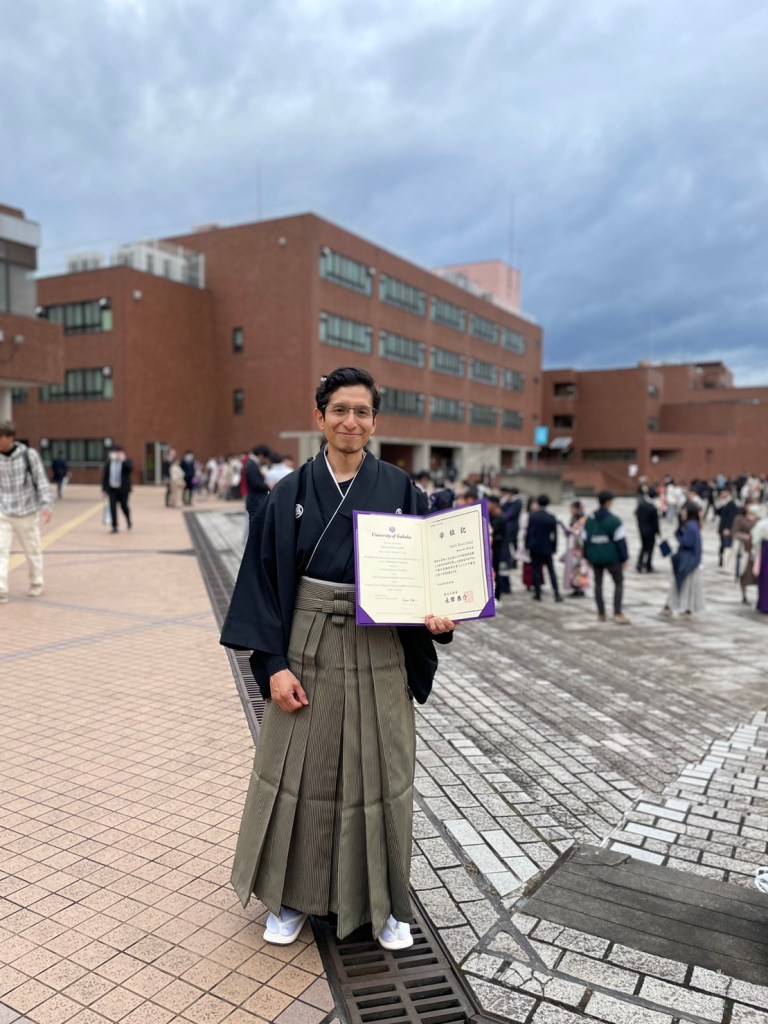
Good afternoon, everyone. Greetings to President Nagata, Deans, Professors, Families, and the class of 2023. Thank you for letting me to share some words in this important graduation ceremony.
It is again spring, and earth reminds us of its cycle through which life renovates itself. Again spring gives us an excellent example of the resilience of life and inspires us to think of our human paths in the same way, as paths of resilience through which knowledge and heart contribute to humankind’s growing and renovation cycles.
The last years have been quite a unique journey of challenges. We have all experimented hardship and frustration because of the pandemic, but at the same time, hope and an incredible opportunity for silence and deep reflection. I came from Mexico in 2019 and entered the Doctoral Program in Humanities three years ago, just when the COVID-19 pandemic made us retreat to our houses and challenged us to continue our studies in new ways. I was incredibly amazed by how our professors and the academic staff kept going and envisioned new ways and opportunities to continue the classes and activities of the University. I am incredibly thankful to all of them because they taught me how education is sustained not merely in books or information but in people and the daily effort of making the connections for technology to be useful and take care of life. In addition, I discovered how much knowledge is connected with life, within the intimate scope of our families, friends, nature, and God. Knowledge is connected to all the intimate relationships through which we can participate in growing a healthy society.
Also, studying during the pandemic opened new doors for me: a new way to enter into contact with nature and a more subtle rhythm of life, taking care of myself and building awareness of the people around me. Japanese society also showed me their unique strength in front of adversity, and I received many demonstrations of solidarity and generosity from my friends that I will never forget.
The University of Tsukuba provided me with a safe space. Its beautiful campus, surrounded by nature, became a second home for my silent readings and research activities. The environment showed me how nature supports, with its therapeutic presence and beauty, the development of human knowledge, because we are nature too. Tsukuba University community also includes its kobushi, sakura, ume, sarusuberi, metasequoia, ginkgo, momiji and keyaki trees, its fauna and ponds, its laboratory and research animals, just as library and cafeteria. I am especially thankful to all the people who take care of those spaces and lives for providing a safe space for research, experiments, dialogue, and reflection. During my research, I had the opportunity to cross between Humanities and Sciences, poetry, and technological innovation, to look at how we care for this world and our human communities from different angles. This opportunity ignited in my path incredible questions about the meaning of study.
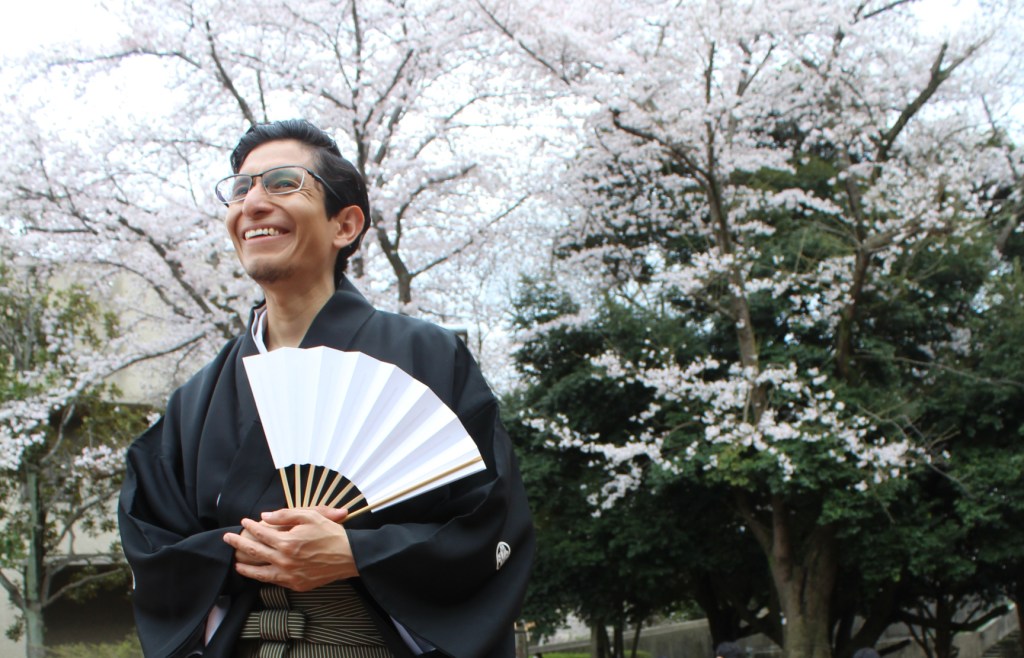
My most significant learning in this University is about making questions, not just theoretical but ethical, what do we aim for when creating knowledge? What do we seek when developing new technologies? What do we strive for when envisioning the future? I would say that it is mainly to walk a path connected to health, peace, and beauty. In times in which many drastic changes are taking place, and the ethical grounds of modernization are constantly being threatened, I wish this University will continue being a refugee for relationships of health, peace, and beauty because those are the paths crossing beyond past and future generations, the pathways of renovation and resilience, just as the flowers of kobushi. In addition, the University of Tsukuba’s international environment has given me an incredible opportunity to envision how these paths intersect and work together rather than diverge and struggle, crossing languages and cultures. An old Aztec poem said that when many wise people and poets from different towns once gathered to discuss the meaning of human life on earth, after a long poetic exchange of many days, they agreed that one of the meanings of life was having that same opportunity to encounter between them. For me, this is the spirit of University, the nature of wisdom through which knowledge can guide our way of living together on earth, creating a world worth living.
I sincerely thank God, professors, families, friends, and all living beings that sustain our lives.
March 24th, 2023
Representative of the class of 2023
Graduate School of Humanities and Social Sciences
Modern Languages and Cultures Program (Ph.D)
Melchy Ramos Yaxkin
 Flor de Amaneceres